Brookfield, GE partnerships advance U.S. reactor projects
Brookfield and The Nuclear Company will pursue Westinghouse AP1000 and AP300 units; Blue Energy and GE Vernova plan a gas-plus-nuclear hybrid in Texas. A national poll found 46% U.S. support for nuclear.
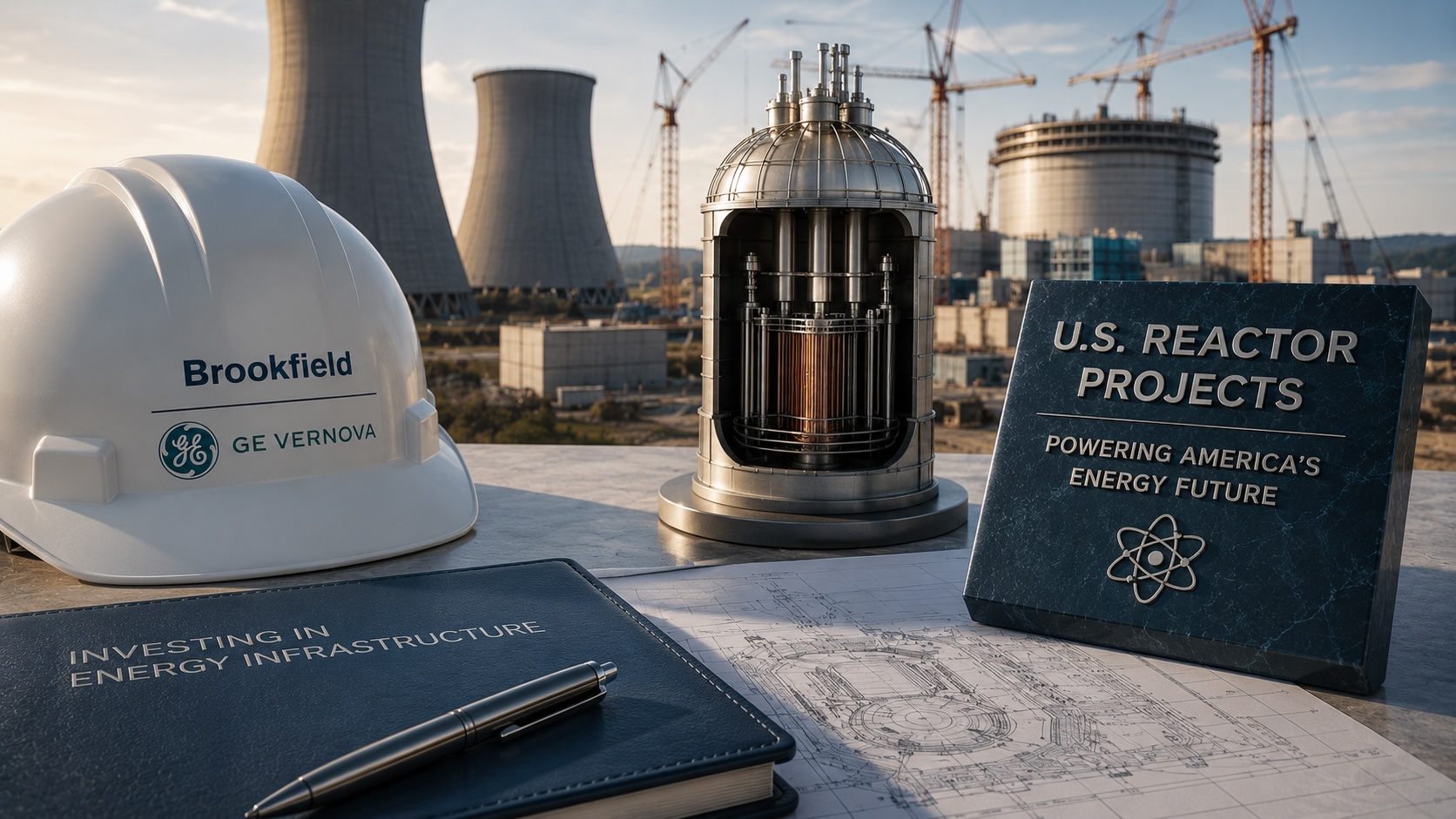
Brookfield Asset Management and The Nuclear Company formed a project execution firm to deploy Westinghouse AP1000 large reactors and AP300 smaller units, while Blue Energy and GE Vernova outlined plans for a gas-plus-nuclear hybrid plant in Texas. A recent national poll showed 46% of U.S. adults favor greater emphasis on nuclear power.
The new Brookfield–The Nuclear Company entity will provide licensing support, engineering, procurement, construction and commissioning for AP1000 and AP300 designs. The Nuclear Company was founded by managers who worked on Vogtle Units 3 and 4. The partners expect initial work to focus on the partially completed V.C. Summer AP1000 units in South Carolina; any restart requires due diligence, regulatory approvals and a final investment decision.
Westinghouse is majority owned by Brookfield with a 51% stake and by Cameco with 49%. The U.S. has backed efforts to expand AP1000 deployment nationally. The Nuclear Company plans to use an AI-driven project management system developed during Vogtle to try to keep schedules and budgets predictable.
Blue Energy and GE Vernova described a Texas site that would begin with about one gigawatt of gas-fired generation and later add roughly 1.5 gigawatts of nuclear capacity from an array of GE Vernova BWRX-300 small modular reactors. Initial site work is targeted for 2026. The partners plan to seek a final investment decision and to apply for a Nuclear Regulatory Commission construction permit in 2027. Fuel-fired turbines could energize the site by about 2030, with nuclear units expected as soon as 2032 to serve a nearby data center campus and industrial customers.
The hybrid design uses a natural-gas bridge for near-term power and relies on offsite prefabrication of reactor modules to shorten construction schedules and lower upfront capital needs. The BWRX-300 design has received NRC approval for a resequenced construction approach intended to reduce schedule risk.
The national poll, conducted in late April, measured support for prioritizing nuclear power at 46%, the highest level in 13 years of asking the question and up seven percentage points since 2021. The survey found support for solar and wind at their lowest levels in more than a decade. The poll showed a narrower partisan gap on nuclear than on renewables, while some local opposition to specific plant proposals remains.
Companies that supply fuel, reactors, turbines, engineering and components stand to gain if projects proceed. Cameco would be positioned to supply fuel through its Westinghouse stake. GE Vernova would supply gas turbines and BWRX-300 technology for the Texas project. Engineering, procurement and construction firms and makers of pumps, valves, instrumentation and fuel-handling hardware could win contracts as construction scales.
Large U.S. reactor projects have previously faced cost and schedule challenges. Vogtle Units 3 and 4 experienced significant overruns before entering service, and the V.C. Summer units were abandoned in 2017 after costs escalated. The Brookfield–The Nuclear Company and Blue Energy–GE Vernova arrangements state an intent to apply lessons from those projects, including specialized execution teams and module-based construction methods.
Both projects remain subject to regulatory approvals, due diligence and final investment decisions before construction can proceed.
Tags
Articles by this author