What does liquidity mean in finance?

Lehman Brothers had assets worth hundreds of billions of dollars when it filed for bankruptcy in 2008. It did not run out of assets. It ran out of liquidity. Owning something valuable and being able to use that value when it counts are not the same thing. That gap sits at the heart of how finance actually works.
On this page
Liquidity in finance and how does it work?
Liquidity measures how quickly and cheaply an asset can be converted into cash without a significant loss in value. Cash is the benchmark: perfectly liquid by definition. A large-cap stock trading on a major exchange sits near that end of the spectrum. Commercial real estate, a private equity stake, or a stake in a closely held business sits much further away – selling any of them takes time, carries transaction costs, and usually means accepting a price below the theoretical valuation.

But liquidity is not only a property of assets. It applies at three distinct levels, and each one matters.
- Asset level: liquidity describes how tradeable something is.
- Company level: whether a business has enough accessible cash or near-cash resources to cover what it owes in the short term.
- Market level: it describes how efficiently participants can buy and sell without moving prices significantly. A thinly traded bond market, for instance, can make even a modest sell order look like a major event.
All three levels feed into each other. A company holding illiquid assets may be perfectly solvent by any accounting measure and still face a crisis if it cannot convert those assets to cash before a payment falls due. Lehman, again, is the textbook case. Solvency and liquidity are related but not the same thing, and conflating them is an expensive mistake.
One more property worth flagging: liquidity is not stable. In normal conditions, markets function smoothly and assets trade near their stated value. Under stress, buyers disappear, spreads widen, and the same assets become much harder to sell. Liquidity tends to evaporate exactly when it is needed most.

Types of liquidity explained
Finance uses the term in several overlapping ways, and the types of liquidity each describe something different.
Market liquidity captures how freely an asset changes hands. A market is liquid when there are many buyers and sellers, spreads between bid and ask prices are tight, and large transactions do not move the price much. US Treasuries and major equity indices represent the deep end of this pool. Thinly traded corporate bonds or small-cap stocks in frontier markets represent the shallow end, where a single institutional order can shift prices materially.
Accounting liquidity shifts the focus from the asset to the balance sheet. It measures whether a company has enough short-term assets to cover its short-term liabilities. A business can be profitable, even asset-rich, and still face a liquidity crisis if what it owns cannot be quickly converted to cash. Inventory piling up in a warehouse, receivables sitting unpaid at 120 days, or capital locked in long-term investments all erode accounting liquidity without touching the income statement.
Funding liquidity is a third dimension, most relevant for banks and other financial institutions. It refers to the ability to raise cash through borrowing – via the repo market, from depositors, or through short-term debt issuance. Institutions that depend heavily on short-term wholesale funding carry a specific vulnerability: if those funding markets close, even temporarily, the pressure builds fast regardless of what the balance sheet says.

How liquidity is measured
Measuring liquidity risk starts with ratios, each one drawing the line at a different point.
The current ratio compares all current assets to current liabilities. A figure above 1 means short-term assets exceed short-term obligations. Below 1 is a warning sign, though context matters: some industries routinely operate with low current ratios without issue.
The quick ratio tightens the lens by removing inventory from the asset side, on the logic that stock cannot always be sold quickly at full value. A company can look healthy on the current ratio and considerably less so on the quick ratio if its current assets are mostly unsold goods.
The cash ratio goes further still, counting only cash and cash equivalents. It is the harshest cut: what can the company cover if nothing else comes in?
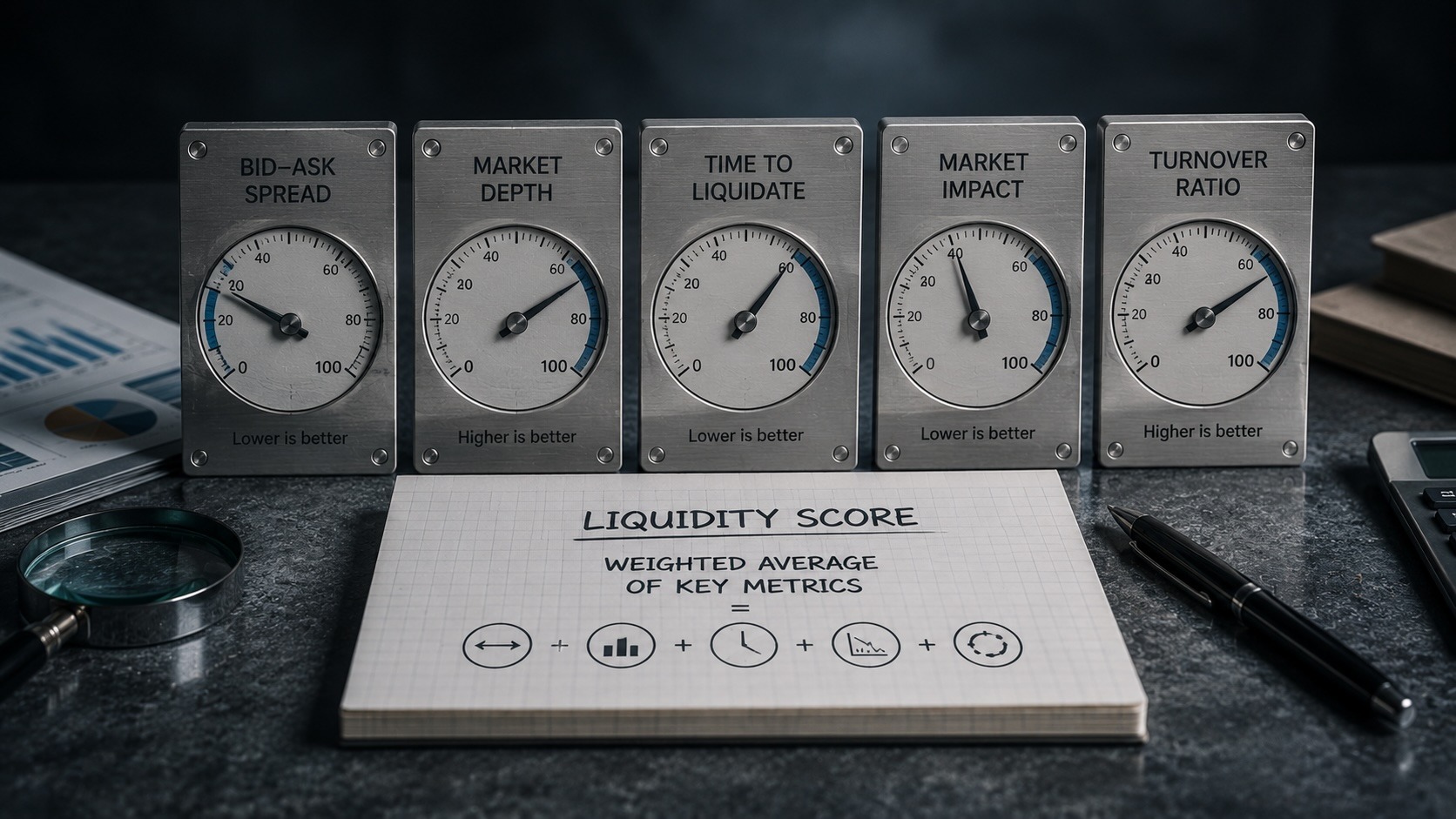
In capital markets, analysts look at bid-ask spreads, trading volumes, market depth, and price impact – how much a transaction of a given size moves the price. For less liquid portfolios, days-to-liquidate estimates give a practical measure of exit risk.
Regulators apply their own framework to banks. The Liquidity Coverage Ratio requires institutions to hold enough high-quality liquid assets to survive 30 days of stressed outflows. The Net Stable Funding Ratio takes a longer view, matching the stability of funding sources against the liquidity profile of assets on the balance sheet.
Why liquidity matters
Liquid means accessible. In finance, what does liquid mean in practice is often the difference between a problem that can be managed and one that cannot.
For companies, liquidity is the buffer between a difficult quarter and an existential one. Businesses that maintain adequate liquidity can meet obligations without forced asset sales, keep relationships with suppliers and creditors intact, and move quickly when an acquisition or investment opportunity appears.
For investors, illiquidity is a risk factor that standard return calculations tend to underweight. The illiquidity premium is real – investors do earn more, on average, for holding assets that are harder to exit. But that premium comes with a constraint: when conditions deteriorate and the position needs to be reduced, the exit may be slower and more costly than the entry ever suggested.
At the systemic level, liquidity is what keeps markets functioning. When it breaks down, as it did in 2008, in the March 2020 Treasury market dislocation, and in the UK gilt crisis of 2022, central banks step in because the alternative is a chain of forced selling that spreads far beyond the original problem. Liquidity failures do not stay contained.
Articles by this author