AI complacency risks in wealth management

An adviser nearly missed a wrong trust clause after accepting an AI estate summary without checking source documents; Leigh Coney of WorkWise warns of rising fiduciary risk.
An adviser accepted an AI-generated summary of a client’s estate without checking the underlying documents and almost missed an incorrect trust provision. The review took place last year; the adviser noticed the issue only after a phrasing in the summary felt off. Leigh Coney, founder of WorkWise Solutions, described the incident as a near miss, noting the adviser ‘caught it, barely’ and that a month earlier he likely would have let the report pass.
Coney has observed similar behavior across advisory firms. He reported that when AI tools are correct more than 90% of the time, advisers tend to relax their checks. He said what used to take 15 minutes to review often shrinks to two minutes. Researchers refer to the pattern as automation complacency.
The types of errors that can remain unseen include incorrect cost basis entries, stale contribution limits and AI descriptions of rules that have changed. Those errors may not surface until they are applied in a client’s plan, at which point the adviser faces potential fiduciary exposure.
Coney recommends distinguishing low-stakes from high-stakes AI outputs. He gave an example: ‘An AI-drafted meeting recap is low stakes; skim it and move on.’ He said any output that affects client actions — distribution amounts, tax assumptions or beneficiary details — should be verified against source documents every time.
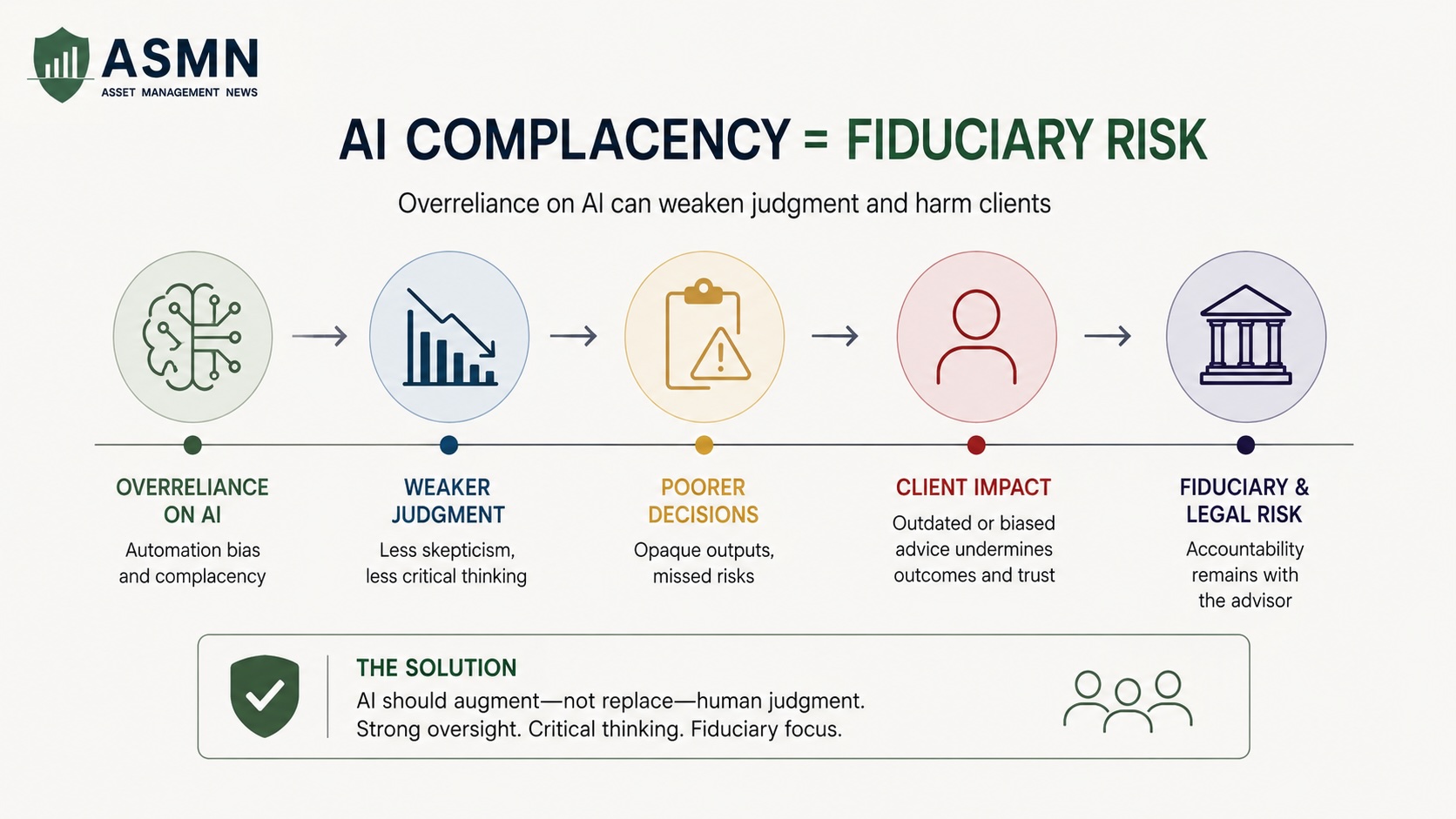
He also advises keeping humans involved in first-pass analysis. If AI pulls accounts together and runs baseline projections for every plan, advisers may lose the practice needed to spot errors. Coney suggested rotating initial analysis between people and machines, rebuilding some projections by hand and checking tax assumptions directly against source records. He compared the practice to pilots who log hand-flying hours to keep instincts sharp.
On product selection, Coney favors models that cite their sources because those let advisers verify outputs quickly. Models that produce fluent assertions without traceable reasoning leave advisers to either trust the output or reproduce the work. He warned: ‘Be suspicious of fluency — the smooth, confident phrasing that makes any answer sound authoritative.’ He added, ‘Confidence is not accuracy.’
Coney urged firms to formalize which review steps must be done by a person and to record those requirements in writing. He recommended designing workflows that enforce mandatory checks and using the time freed by AI for manual verification and continued practice rather than for additional unchecked tasks.
Articles by this author