Is cash considered an asset?

Of all the things a business can own, cash is the one that requires the least explanation to value. Yet its classification in accounting is worth understanding precisely, because cash behaves differently from most other assets and occupies a unique position on the balance sheet.
Cash definition
In accounting and business finance, cash covers more than physical notes and coins. The term encompasses bank account balances, demand deposits, and cash equivalents – short-term instruments that can be converted to a known amount of cash within three months without significant risk of loss. Treasury bills, money market funds, and certain short-term commercial paper all fall into this category.
What is cash for a business? It is the most liquid resource a company holds – the foundation of payroll, supplier payments, debt servicing, and day-to-day operations. Businesses rely on cash to pay employees, settle obligations, fund investments, and handle unexpected expenses as they arise. A company with strong cash reserves has more flexibility, while one running low on cash faces constraints regardless of what the rest of the balance sheet shows.
Is cash an asset?
Cash is an asset – and specifically, the most liquid one. Under standard accounting frameworks, an asset is a resource owned or controlled by an entity that is expected to deliver future economic benefit. Cash satisfies this definition more directly than almost anything else on the balance sheet.
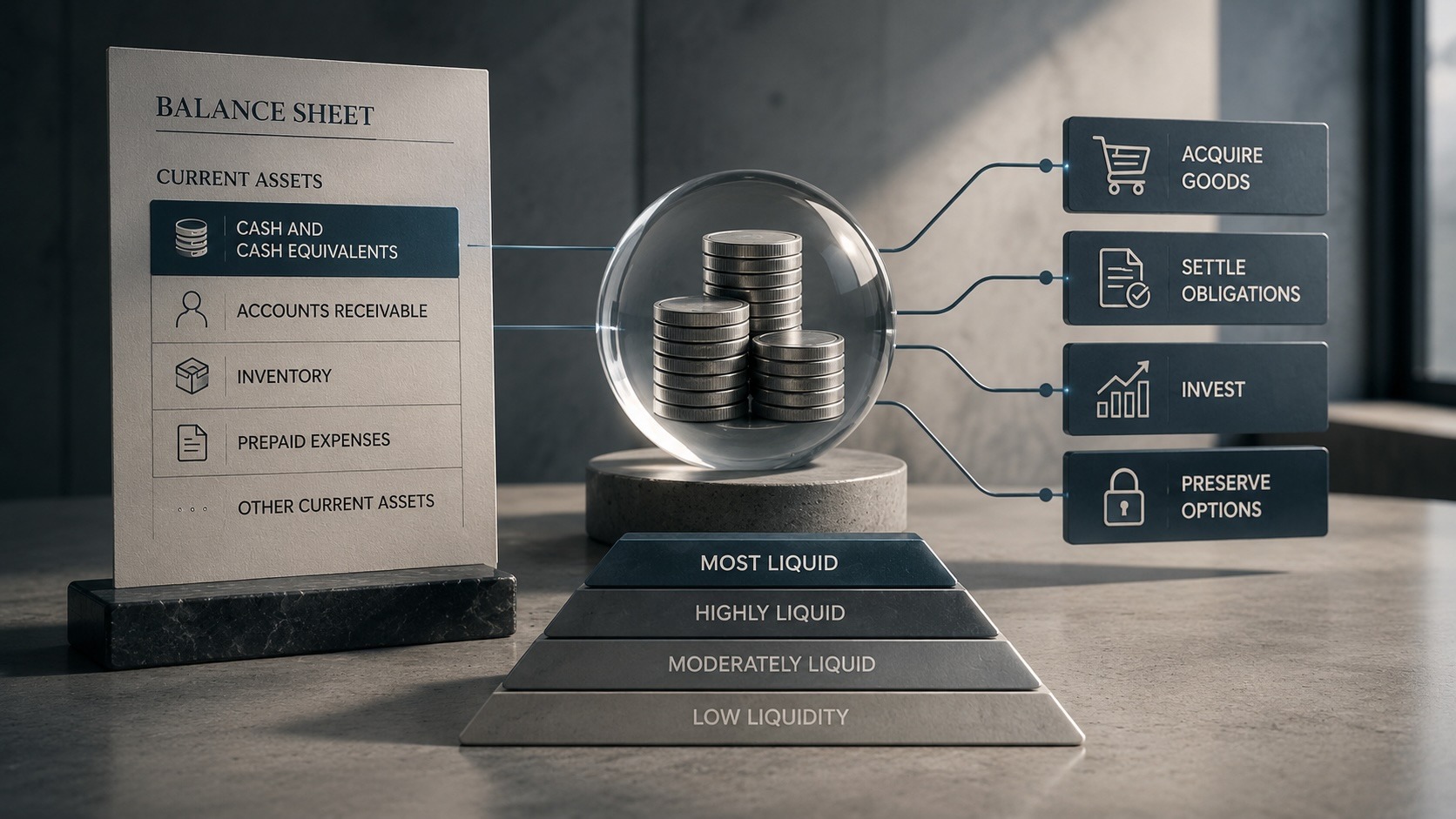
Is cash considered an asset partly because of its flexibility? Yes – cash can immediately be used to settle obligations, make investments, acquire goods, or preserve liquidity without needing to be converted first. That capacity to deliver economic benefit on demand is precisely what places it at the top of the asset hierarchy.
In accounting, cash appears under current assets, the category reserved for resources expected to be used or converted within twelve months. Among current assets, cash is the reference point against which all others are measured: receivables are valued based on how reliably they convert to cash, inventory based on how quickly it can be sold for cash, and so on. Liquidity largely determines how assets are treated operationally and on the balance sheet.
On a balance sheet, cash and cash equivalents typically appear as the first line item under current assets – a convention that reflects both its liquidity and its role as the operational foundation of the business.
Is cash an asset or liability?
Cash is an asset to whoever holds it. Whether it becomes associated with a liability depends on where it came from and what obligations are attached to it.
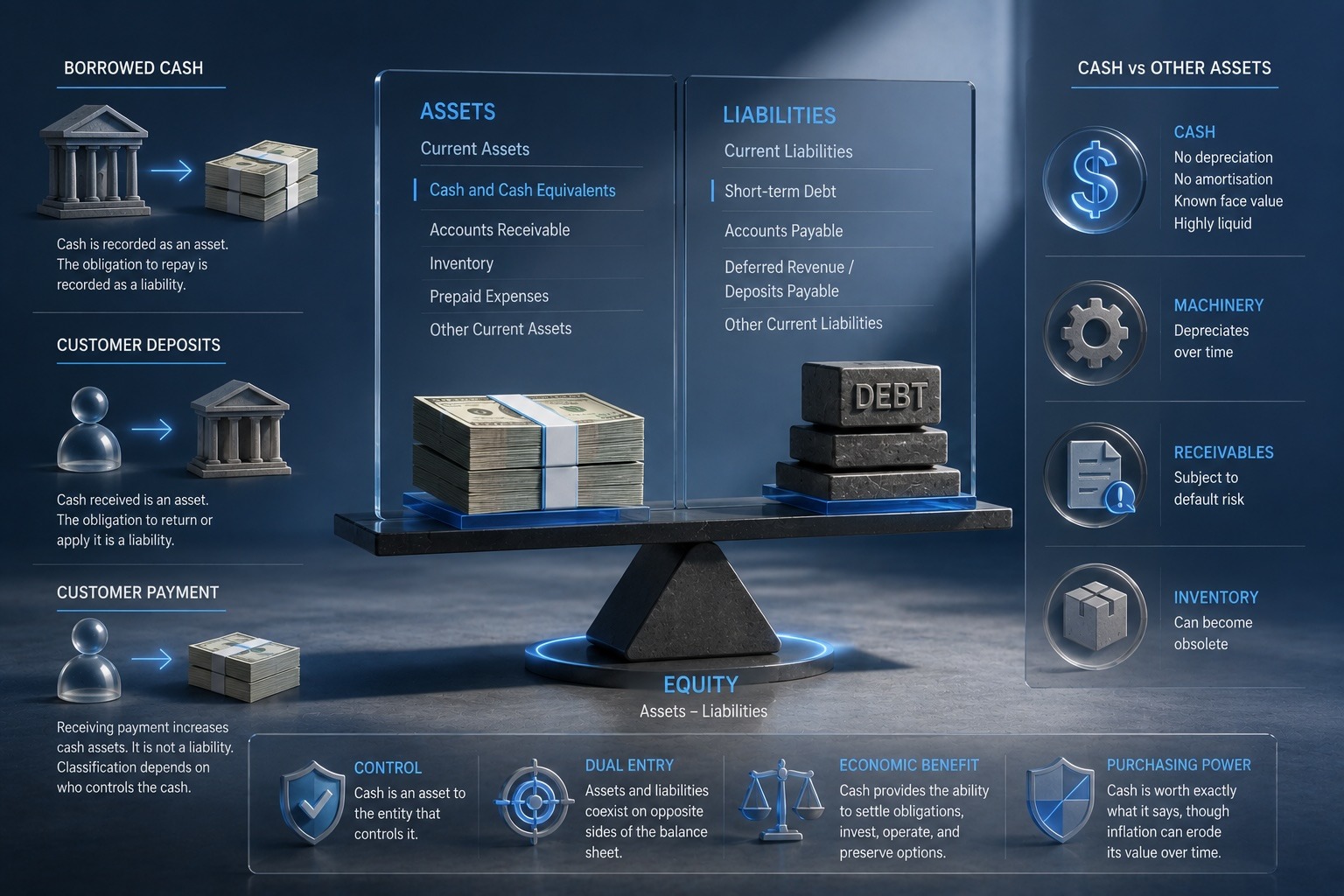
Is cash an asset or liabilities issue when the cash itself comes from borrowed money? Even when the cash comes from debt financing, the cash itself remains an asset, while the repayment obligation appears separately on the liability side of the balance sheet. Holding borrowed cash means carrying both a current asset and a corresponding liability at the same time. The presence of debt does not change the classification of cash itself.
Customer deposits held by a business represent cash received that must eventually be returned or applied – in that case, the corresponding liability is deferred revenue or a deposit payable. Banks face a version of this constantly: customer deposits are cash on hand for the bank, but they are simultaneously liabilities because depositors can withdraw them. For most non-financial businesses, this distinction rarely applies.
More broadly, cash is treated as an asset by the entity that controls it. A company that receives payment from a customer gains a cash asset. It does not gain a liability. The person or entity that paid may have reduced their own cash asset, but that does not change the classification for the recipient.
Cash differs from most other assets because it carries no depreciation, amortisation schedule, or uncertainty around nominal value. A machine loses value over time. Receivables carry default risk. Inventory can become obsolete. Cash, by contrast, is worth exactly what it says – though its purchasing power can erode with inflation, which is one reason businesses do not simply hold all their capital in cash indefinitely.
Final takeaway
Is cash an asset? In accounting, the answer does not vary: cash is classified as a current asset under every major accounting framework, placed at the top of the current assets section precisely because it is the most immediately usable resource a business holds.
Beyond classification, cash is what gives a business the flexibility to meet obligations, pursue opportunities, and absorb unexpected costs without being forced into unfavourable decisions. Asset-rich companies with poor cash positions have failed; cash-generating businesses with modest fixed assets have thrived. Cash position often matters more to day-to-day business stability than the size of a company’s long-term asset base.
Articles by this author