Rolls-Royce shares could reach 1,500p in June

Shares have rebounded to about 1,272p from a Feb. 26 high of 1,418p and may test 1,500p in June as aviation, defense and power orders recover.
Rolls-Royce shares fell from a Feb. 26 high of 1,418p after regional aviation disruptions and have recovered to about 1,272p. Market commentary and chart patterns point to 1,418p as near-term resistance and a possible extension to 1,500p if that level is cleared.
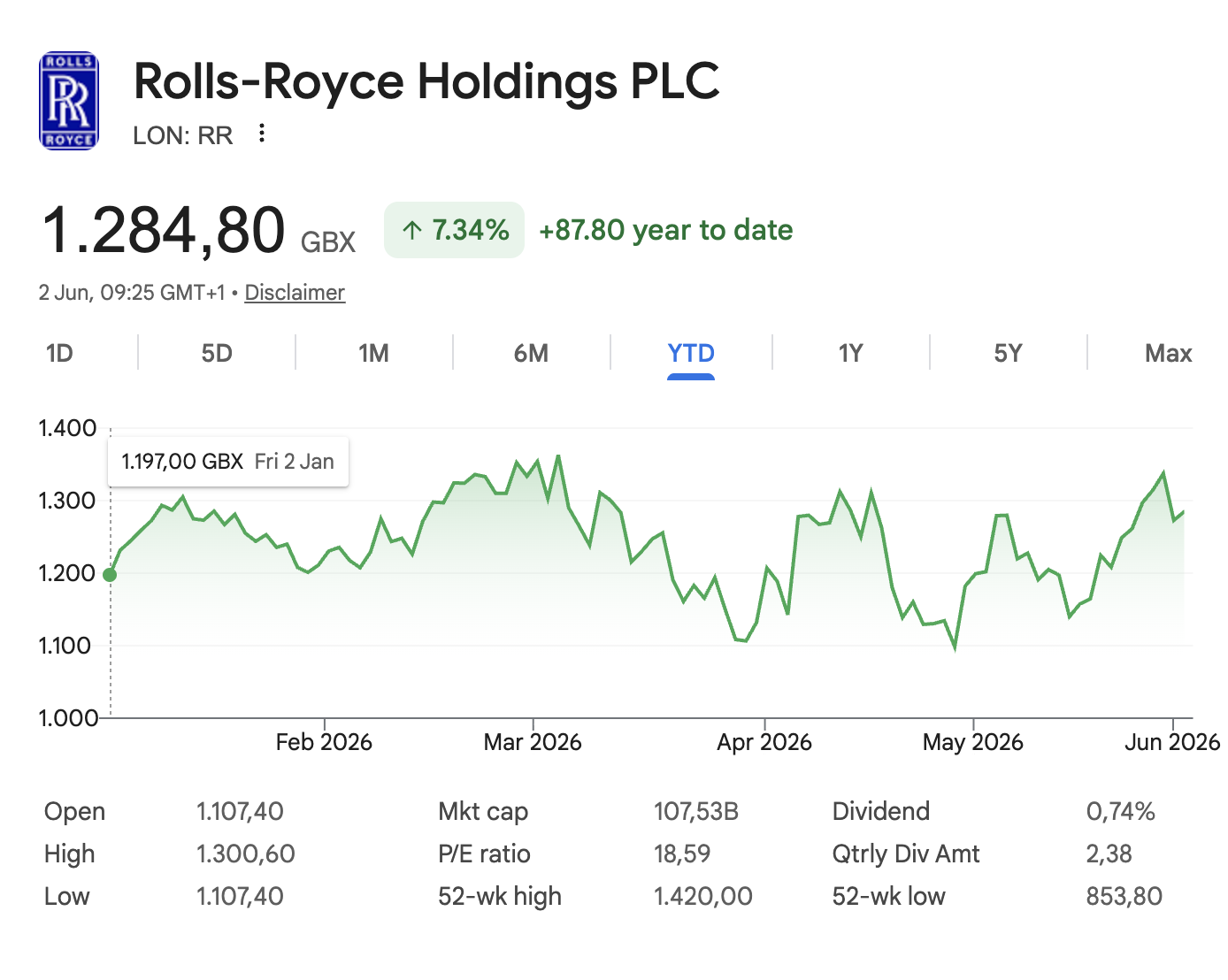
The February peak occurred two days before U.S. and Israeli strikes on Iran that were followed by Iranian drone attacks on regional infrastructure and several airports. Airlines cut or paused services and reduced flying hours, which directly lowers Rolls-Royce’s service revenues because the company bills customers per flying hour for engine maintenance and support.
Company management reported the operational impact was smaller than some analysts had feared, noting most capacity reductions were on narrow-body routes while Rolls‑Royce’s engine fleet is concentrated in wide-body jets used on long-haul services. In a company statement, Rolls-Royce management wrote: “We expect to fully mitigate the current financial impact of the disruption to our business. We continue to monitor the situation for any future direct and indirect impacts and will take the necessary actions to mitigate them.” The company maintained targets of roughly £4.2 billion in profit and about £3.8 billion in free cash flow for the year.
Beyond civil aviation, the defense division may see support from increased military spending in Europe and a U.S. proposal for about $1.5 trillion in defense spending this year, which could sustain demand for engines and military power systems. The power segment reported stronger orders for equipment used in data centers, hitting a record in March, and the backlog rose above £7.3 billion. Rolls-Royce is also investing in small modular reactor technology as a longer-term energy business.
Technical indicators show the stock rebounded from a March–April low near 1,092p to around 1,272p and remains above its 100-day moving average. The price is trading along a descending trendline that links the February highs. Analysts and chart watchers identify a sustained break above 1,418p as the next trigger that could open the path toward 1,500p.
Investors will monitor quarterly order flow and service revenue for signs of recovering long‑haul flying hours, and whether defense and data‑center contracts convert into near-term revenue. Management’s guidance and the reported power backlog provide milestones to assess progress against the company’s profit and cash-flow targets.
Articles by this author