How advisors should judge risk in alternatives

At Morningstar’s Chicago conference, CEO Kunal Kapoor asked Jon Gray why private funds are courting advisors amid slower institutional fundraising. Gray noted Blackstone raised about $70B in Q1 and seeks retail investors.
At Morningstar’s conference in Chicago last month, CEO Kunal Kapoor pressed Blackstone President Jon Gray on why private equity and private credit firms are increasingly courting financial advisors as institutional fundraising shows signs of slowing. Gray responded that Blackstone raised roughly $70 billion in the first quarter, about half from institutional investors, and that the firm has focused on individual investors and their advisors for 25 years.
The three-day event at Navy Pier drew about 2,000 attendees. Panels covered liquid alternatives, commodities, cryptocurrencies and private credit. Morningstar’s wealth division introduced model portfolios developed with Apollo Global Management, Franklin Templeton and JPMorgan Asset Management that combine public and private investments and aim to provide independent research and clearer pricing.
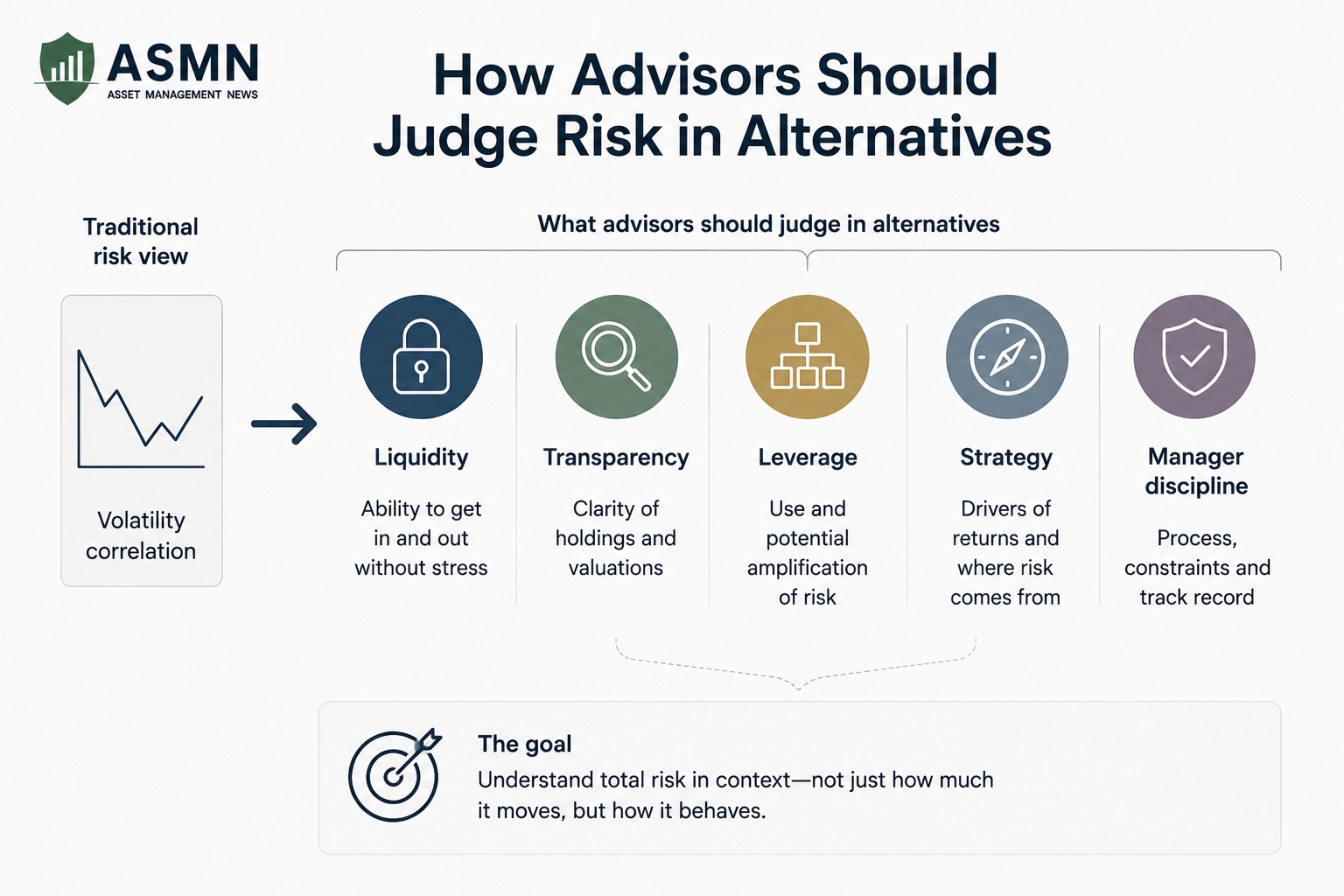
Panelists offered frameworks for evaluating liquid alternatives. Catherine LeGraw of GMO recommended that advisors review after-fee returns, correlation with other assets, the opportunity set and the use of leverage when judging whether a strategy can meet its objectives. Ranjan Bhaduri of Bodhi Research Group urged advisors to compare alternative products against relevant benchmarks and to break client portfolios into components so investors understand the trade-off between liquidity and yield.
Speakers discussed diversification and what different assets hedge. Michele Freed of BlackRock advised choosing low-correlation assets to provide balance against distinct risks. Juan Leon of Bitwise described bitcoin as having different return drivers than stocks and bonds and noted that its relationship with gold changes by time horizon, observing that “bitcoin and gold rhyme over a decade but diverge over a quarter.” Greg Sharenow of PIMCO pointed to recent valuation swings tied to artificial intelligence developments and volatility in the oil market as examples of how interlinked risks can affect commodities and crypto.
Private credit drew attention for the gap between headlines about defaults and managers’ long-term records. Brad Marshall, global head of private credit strategies at Blackstone, recalled 36 defaults over more than 20 years among the thousands of borrowers his team has financed and highlighted that yield and seniority in deal structures can offer recovery options for lenders. Caitlin Nemeth, a portfolio manager at Cliffwater, advised against waiting until market stress to consider redemptions, saying liquidity planning should begin when a position is established.
Speakers also contrasted public and private fixed-income markets. Sonali Pier of PIMCO noted that public markets have reset base rates and currently offer higher yields, and that investors can find liquidity, diversification and credit quality in public fixed income today.
Panels addressed fees and account types. Gray indicated Blackstone will consider flat-fee options for retirement-focused products where clients seek fee certainty and where lower distribution costs and longer expected capital duration could allow simpler fee structures while maintaining target net returns.
Throughout the conference, panelists returned to the advisor’s role in selecting alternatives: explain the purpose of each allocation, match products to appropriate benchmarks, and consider liquidity, fees and sensitivity to economic conditions before recommending private or liquid alternatives. Panelists emphasized manager commitment, operational infrastructure and transparency as factors advisors should evaluate when assessing alternative investments.
Articles by this author