FinCEN warns banks: IRGC uses crypto, front companies

FinCEN told U.S. banks on May 11 that Iran’s Islamic Revolutionary Guard Corps uses cryptocurrencies, front companies and opaque service providers to evade U.S. sanctions.
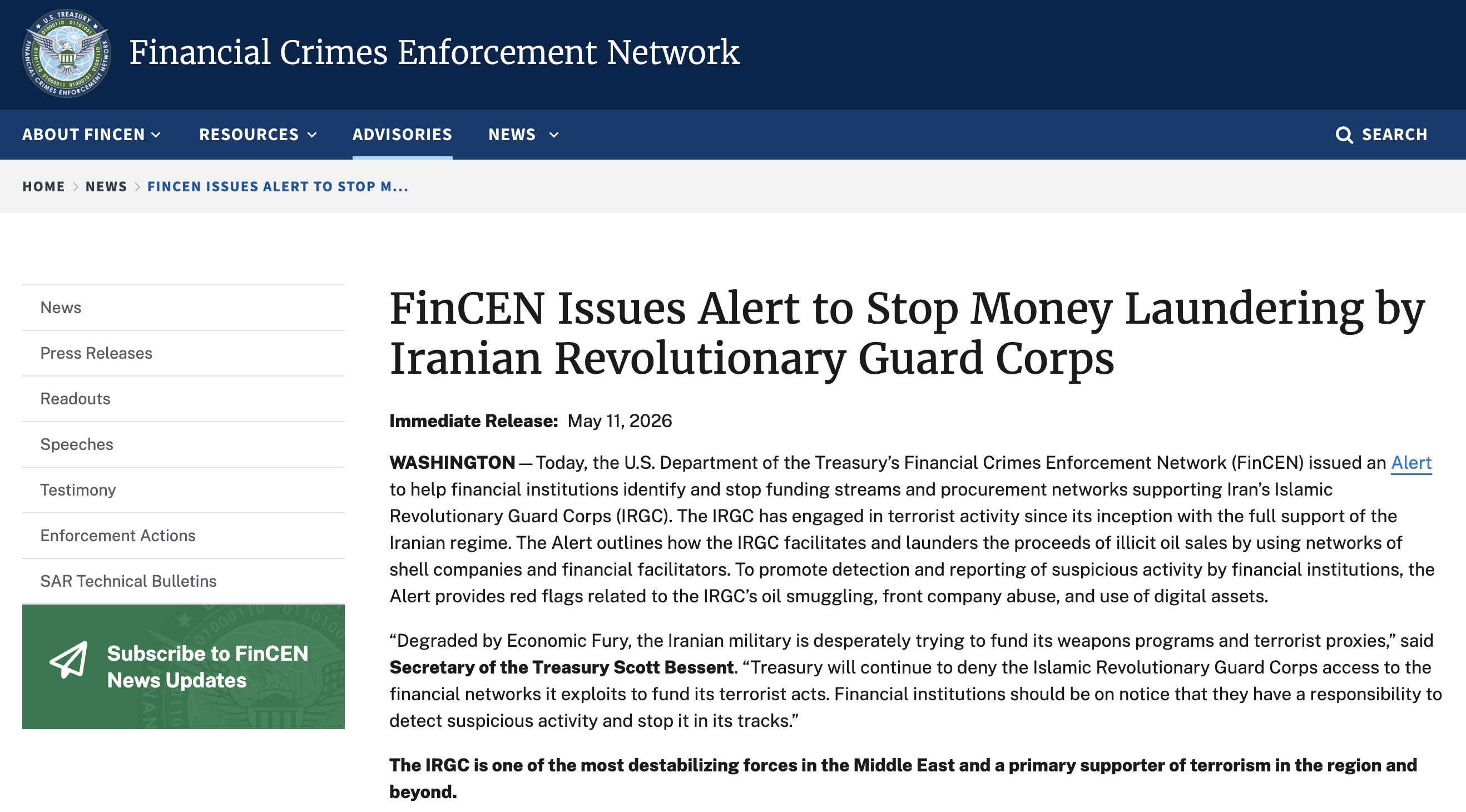
On May 11 the U.S. Treasury’s Financial Crimes Enforcement Network issued an advisory to banks nationwide warning that Iran’s Islamic Revolutionary Guard Corps is using digital assets, front companies and opaque service providers to evade U.S. sanctions. FinCEN estimated activity linked to Iranian government and IRGC entities could total billions of dollars a year.
The advisory targets IRGC procurement networks and identifies specific techniques. FinCEN described front companies that appear legitimate but funnel funds to sanctioned entities and ‘‘obfuscated transactions’’ that hide the origin, destination or purpose of crypto transfers. The agency did not name particular tokens, exchanges or firms.
FinCEN traced these methods to at least 2019. State-supported Bitcoin mining that relied on subsidized electricity allowed Iran to generate crypto that could be spent internationally without using traditional banking channels. Coin-mixing services, brokers and over-the-counter desks have been used to move larger volumes and make transaction trails harder to follow.
The notice directs banks to increase monitoring for transactions tied to front companies in jurisdictions commonly associated with Iranian trade, to flag unusual patterns of fiat-to-crypto or crypto-to-fiat conversion, and to scrutinize service providers with opaque ownership structures that could act for sanctioned actors. The advisory also warns crypto platforms that serve U.S. customers or seek access to U.S. markets to strengthen compliance programs.
FinCEN presented the alert as a nationwide instruction to heighten monitoring and to report suspicious activity related to apparent Iranian sanctions evasion. The IRGC has been designated a foreign terrorist organization by the U.S. since 2019 and has commercial reach across construction, telecommunications and energy that can support procurement networks.
Compliance and enforcement professionals expect the advisory will lead to more intensive know-your-customer checks, enhanced transaction monitoring and closer vetting of counterparties and service providers. Customers and platforms may see additional steps at onboarding and when converting between fiat and crypto.
Tags
Articles by this author