Is land a fixed asset? How land is classified in finance

Land has long been treated as a store of value. In accounting and corporate finance, though, its classification follows specific rules worth understanding – because land behaves differently from almost every other asset a business can hold.
On this page
What is land?
What is land if not the most permanent asset on a balance sheet: a tangible, non-depreciable resource that represents ownership of a defined piece of real property. It has physical form, a legal title, and in most cases a market value that reflects what a willing buyer would pay for it.
Who holds land and why determines its economic function. A manufacturing company owns the ground its factory sits on. A property developer holds land as the raw material for future projects. An institutional investor acquires it as a long-term store of value or an inflation hedge. In each case, the land appears on the balance sheet, but the logic behind holding it differs considerably.
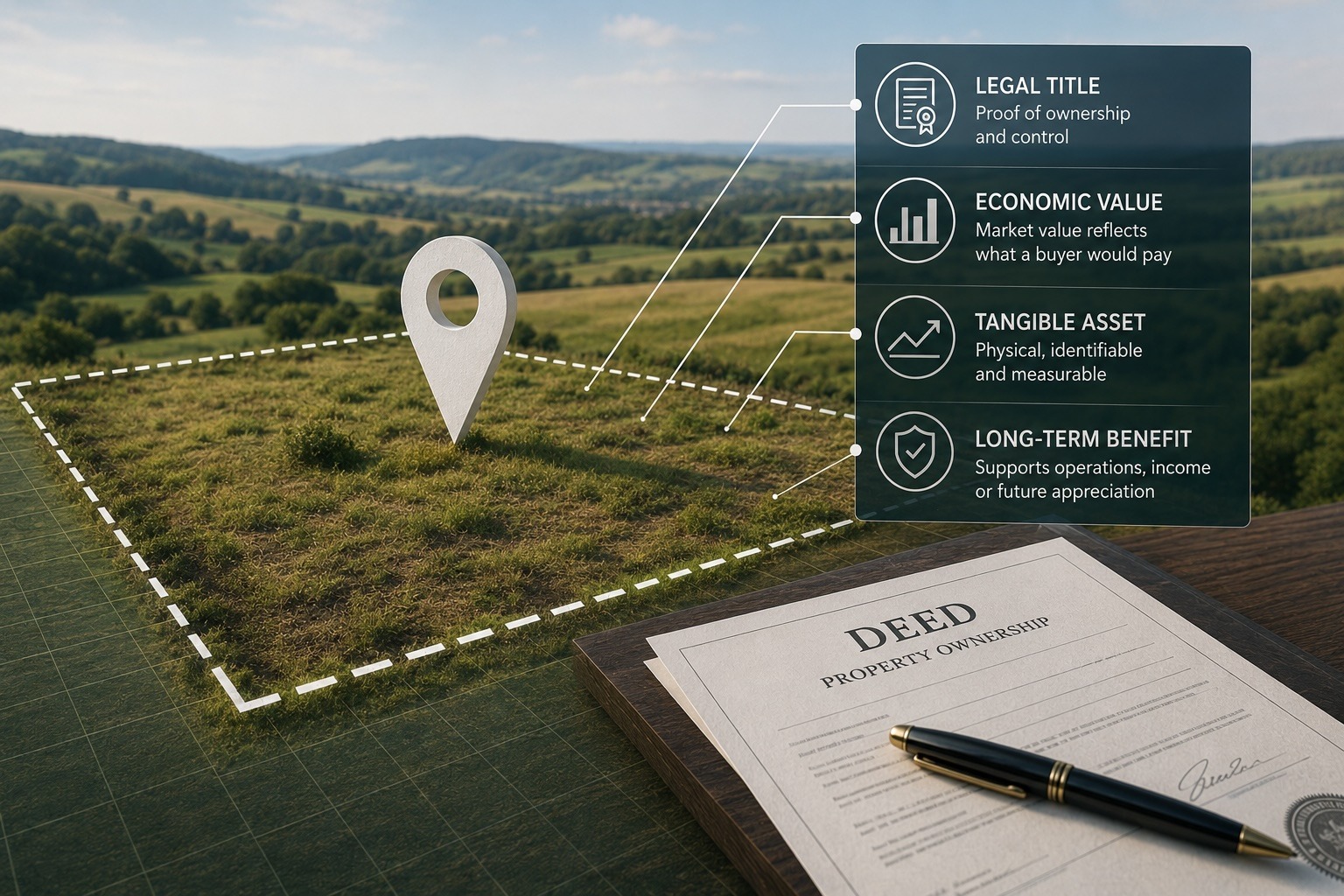
What makes land unusual is that, unlike most physical assets, it does not depreciate through use. Other long-term assets lose value through use: a factory building ages and requires maintenance, equipment becomes obsolete, a vehicle depreciates from the moment it leaves the lot. Land retains its form regardless of how long it is held, which has direct consequences for how it is recorded and reported.
Is land an asset or liability?
Land sits on the asset side of the balance sheet, not the liability side, and the reasoning is grounded in the basic accounting definition: an asset is a resource owned or controlled by an entity that is expected to deliver future economic benefit.
Legal title establishes ownership. The holder decides how the land is used, whether it generates rental income, when it might be sold, and whether it serves as collateral for debt. The land may appreciate in value over time, support active business operations, or simply sit as a strategic reserve. Each of these represents a form of future economic benefit.
A liability works differently – it is an obligation owed to another party. Holding land creates no such obligation. A mortgage secured against land is a liability, but the land itself is not. The two sit on opposite sides of the balance sheet, with the difference between them representing the owner’s equity in the property.
Things become more complicated when land carries environmental contamination, unresolved remediation obligations, or legal encumbrances. These can generate associated liabilities, but they attach to the circumstances of ownership rather than altering what the land itself is. The classification remains the same.
Is land a current or fixed asset?
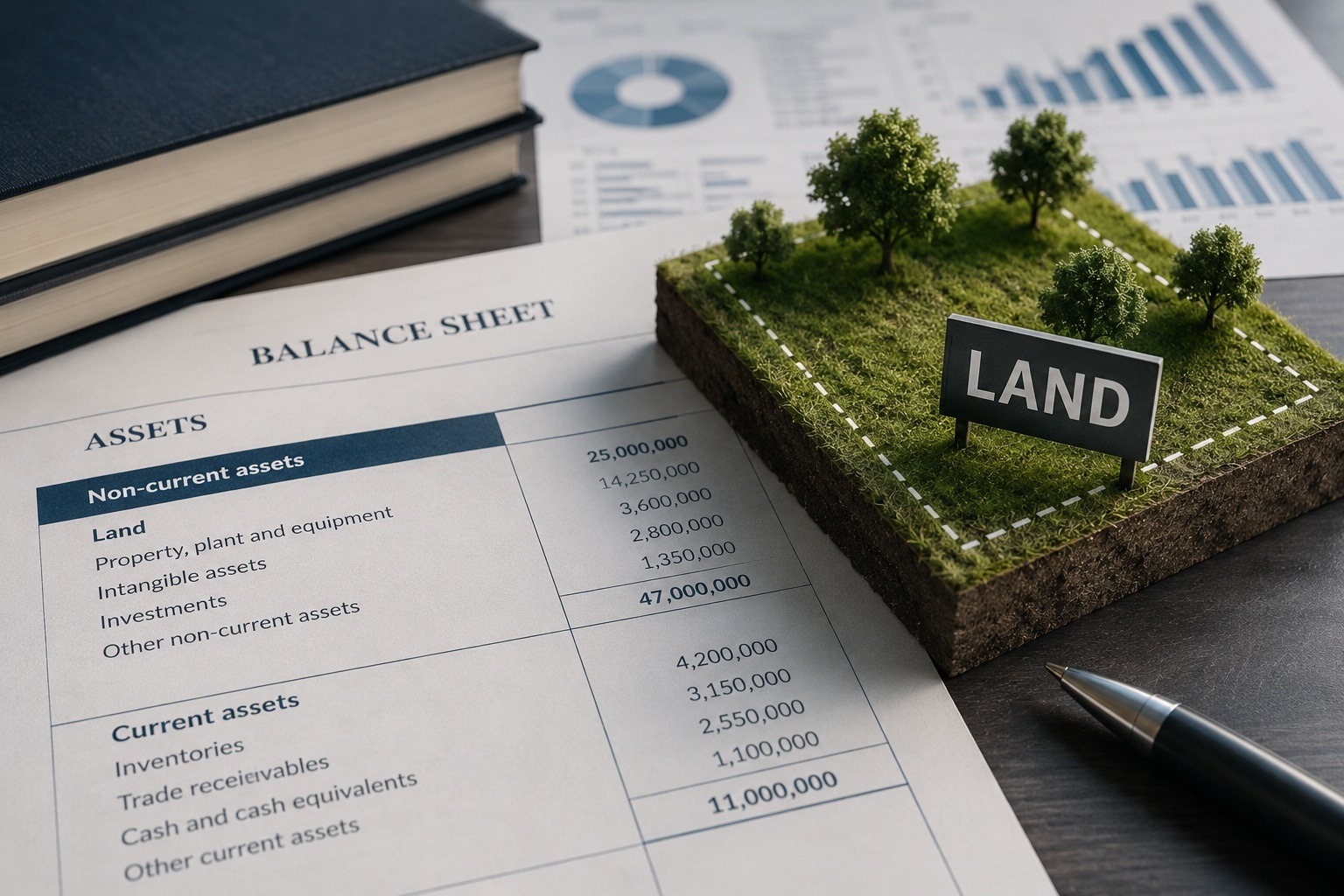
Whether land is a current asset or a non-current one depends on how the holding company intends to use it – and for most businesses, the answer is non-current.
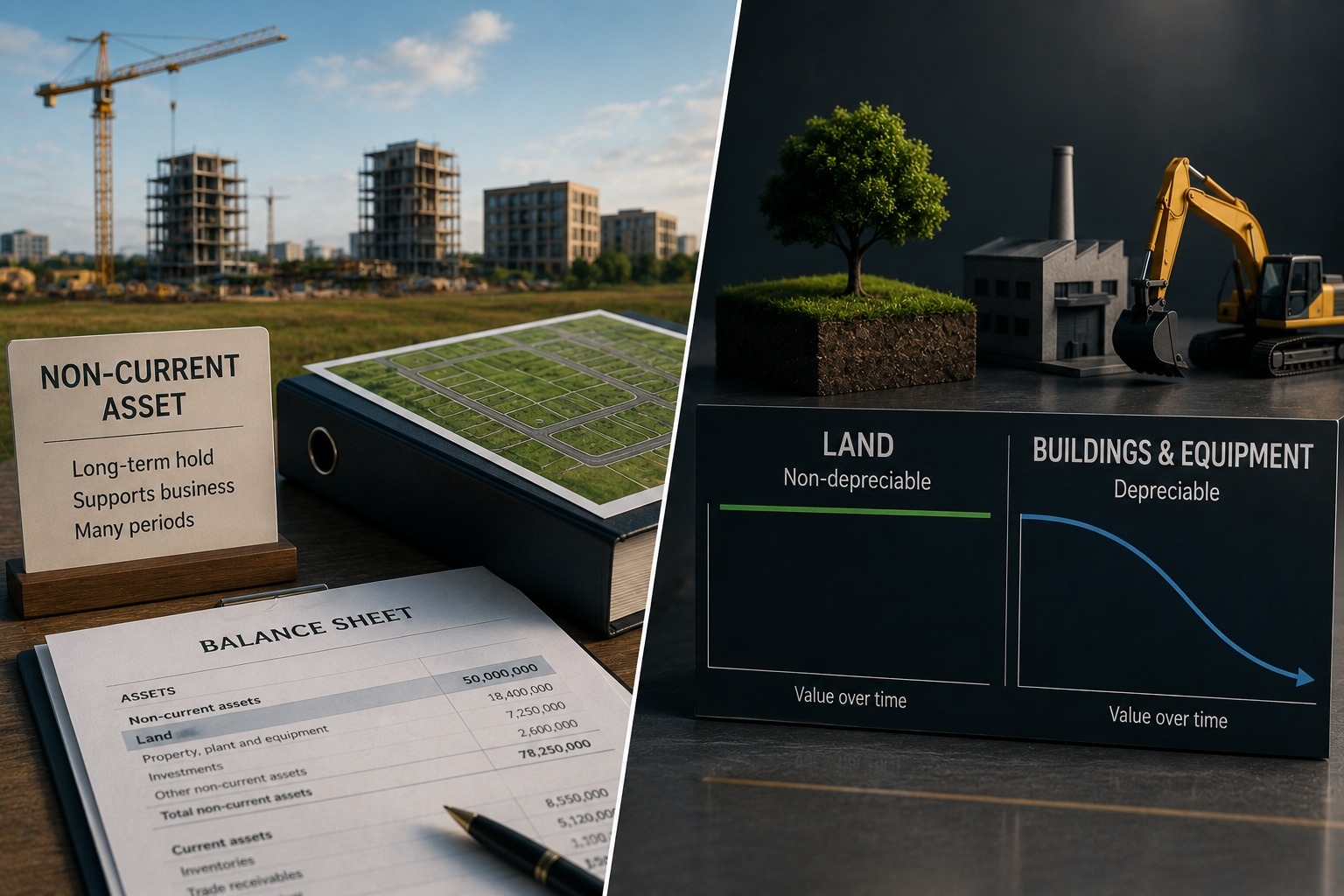
Current assets are those expected to convert to cash within twelve months: receivables, inventory, short-term securities. They reflect the resources cycling through the business in normal operations. Non-current assets serve a longer-term purpose, supporting the business across multiple periods rather than being consumed or liquidated in the near term. For most companies, land is treated as a non-current asset.
Property developers and real estate companies sometimes hold land specifically to build and sell within their normal operating cycle. In that context, the land is not a long-term investment – it is inventory, the raw material that becomes the product. Accounting standards permit classification as a current asset in these cases, which is why the same underlying thing can appear in different places depending on the nature of the business holding it.
The more significant distinction for land, compared to other non-current assets, is depreciation. Under both IFRS and US GAAP, land is not depreciated. Buildings are. Equipment is. Land is not, because accounting standards treat it as having an indefinite useful life rather than one that erodes through use or the passage of time. A factory is depreciated over its expected lifespan; the land it sits on carries the same book value in year thirty as it did in year one.
Over time, this can create a large gap between book value and actual market value for companies that have held land for a long time. The balance sheet shows original acquisition cost; the market may price the same parcel at multiples of that figure. Analysts evaluating asset-heavy businesses or potential acquisition targets often need to account for this gap separately.
Final verdict
Across standard accounting frameworks, land is an asset – specifically a non-current one: tangible, non-depreciable, and recorded at historical cost. It qualifies as an asset because it is owned, controlled, and expected to deliver economic benefit over time, whether through appreciation, income generation, operational use, or collateral value.
The treatment of land matters in two specific ways. First, it never depreciates, so book value and market value can diverge significantly over time. Second, its classification as current or non-current depends on intent: long-term hold means non-current; active development for near-term sale means inventory. That distinction matters when interpreting a company’s balance sheet.
Articles by this author