Retail ETFs move to staples and e-commerce as savings fall

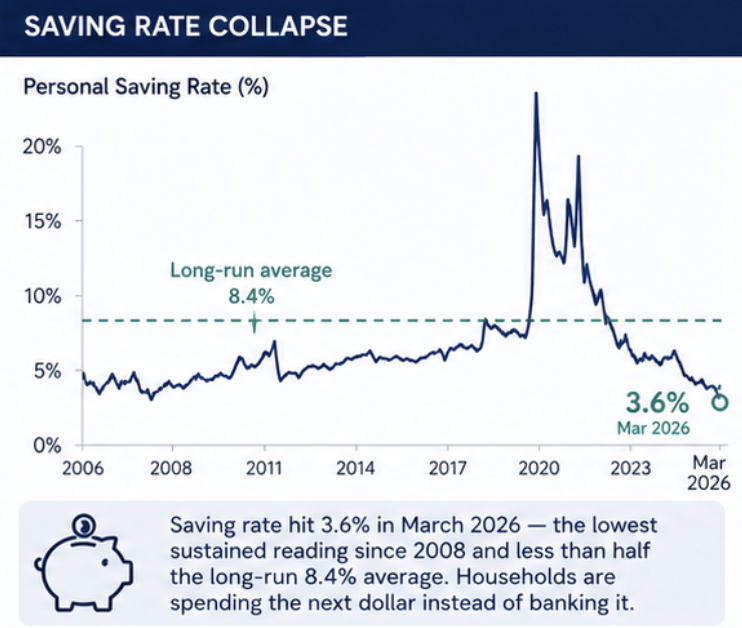
Retail ETFs are adding weight to consumer staples and e-commerce after the U.S. personal saving rate dropped to 3.6% in March 2026 amid reduced discretionary spending.
Retail-focused exchange-traded funds are increasing allocations to consumer staples and e-commerce after the U.S. personal saving rate fell to 3.6% in March 2026 and households reduced spending on nonessential items.
Sector-level ETFs show the shift in holdings. The State Street Consumer Discretionary Select Sector SPDR ETF (XLY) is concentrated in a few large names, with Amazon accounting for about 28% of the fund and Tesla roughly 20%. The remainder of XLY includes traditional retailers, restaurants and lodging companies such as Home Depot, TJX Companies and McDonald’s. The State Street Consumer Staples Select Sector SPDR ETF (XLP) puts more weight on basic-need retailers and packaged-goods companies; Walmart and Costco together represent more than 20% of XLP’s weight.
Retailers with membership models and loyalty programs reported recurring revenue growth in recent quarters. Costco reported total revenue of $69.6 billion for its fiscal second quarter of 2026, up 9.2% year over year, and a U.S. and Canada membership renewal rate of 92.1%. Walmart recorded a 15.1% increase in global membership-fee revenue in its latest quarter, and Sam’s Club membership-fee revenue rose 6.1%.
E-commerce sales continued to expand in early 2026. U.S. retail e-commerce sales were an estimated $326.7 billion in the first quarter of 2026, up 2.7% from the fourth quarter of 2025 and up 9.8% from the first quarter of 2025. E-commerce accounted for 16.9% of total retail sales in the quarter. Overall retail sales rose 1.5% quarter over quarter and 3.9% year over year. Online sales growth extended into grocery, household essentials, health and beauty, and club retail categories.
Large brick-and-mortar retailers reported rising digital sales supported by store networks. Walmart’s U.S. e-commerce segment grew 27% in its most recent quarter, with gains from store-fulfilled pickup and delivery, marketplace activity and advertising. Costco reported digitally enabled comparable sales growth of 22.6%, compared with overall comparable sales growth of 7.4%.
Investors seeking targeted online-retail exposure can find ETFs that focus on internet platforms, payments and logistics. The Amplify Online Retail ETF (IBUY) is the largest global e-commerce ETF with about $110 million in assets and holds names such as eBay, Spotify, Maplebear, Peloton and Affirm. The ProShares Online Retail ETF (ONLN) is market-cap weighted and allocates roughly 25% to Amazon, with Amazon, Alibaba and eBay making up about half of its weight. The First Trust S-Network E-Commerce ETF (ISHP) equal-weights companies across content navigation, online retail, online marketplace and e-commerce infrastructure and includes logistics names such as AP Moller-Maersk and UPS alongside internet platforms.
Consumer staples ETFs have outperformed consumer discretionary ETFs year to date, reflecting higher weightings in companies that sell everyday goods and rely on recurring revenue streams.
Tags
Articles by this author