KNDS IPO guided at €15–18bn after Franco-German deal
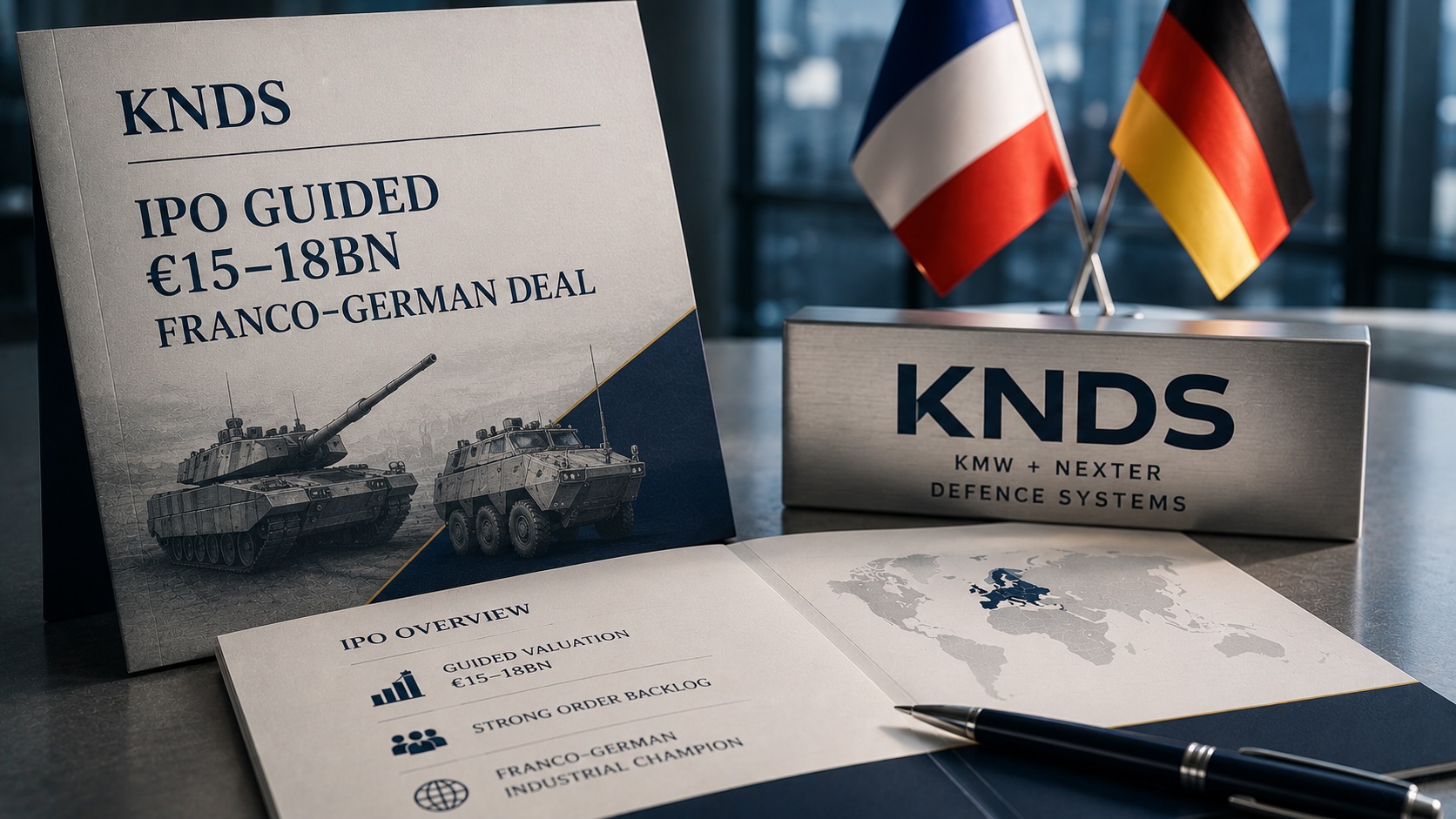
France and Germany agreed governance for KNDS, clearing the way for a dual Paris-Frankfurt IPO as soon as July. Valuation guidance is €15–18bn; about 20% of shares to be sold.
France and Germany struck a governance deal for KNDS that removes the main political obstacle to a dual Paris-Frankfurt IPO as soon as July. The company is guiding a valuation of €15–18bn, below earlier hopes of roughly $23bn, and expects to sell about 20% of shares to public investors while Paris and Berlin retain large anchor stakes.
Under the agreement, Germany will hold about 40% of KNDS after the float, broadly matching France’s position. The European Commission cleared the underlying acquisition without conditions. KNDS plans simultaneous listings in Paris and Frankfurt and could begin the share sale in July, subject to market conditions and investor demand.
The Wegmann family’s decision to sell its holding accelerated the IPO timetable and prompted months of German debate over stake size, veto rights and pricing. The recent deal resolved those disputes and set the ownership structure for the planned listing.
KNDS manufactures land systems including the Leopard 2 main battle tank, the Caesar howitzer, armoured vehicles, artillery and ammunition. The group reported revenue of €4.4bn for 2025, up about 16% year-on-year, and a record order backlog of €33.1bn, roughly 7.5 times annual revenue.
Banks and company advisers have revised valuation expectations downward. The guidance reflects KNDS’s strong order book and the discount investors commonly apply to firms with significant state ownership and complex governance arrangements. After the planned sale the French state and the German anchor shareholder will remain the dominant holders, leaving a minority free float.
In January, an ECM investor noted that “Defense is a major investment thematic now.” In May, an institutional investor described the business as “mostly tanks, not a high‑growth tech story,” emphasizing backlog, manufacturing capacity and sovereign demand rather than speculative technology narratives.
Articles by this author