Global fintech revenue reaches $504B in 2025

Global fintechs generated $504 billion in 2025, up 22% year‑on‑year; 74% of the largest firms were profitable and AI boosted developer productivity.
Global fintechs generated $504 billion in the 12 months to 2025, a 22% increase from the prior year, according to the Global Fintech Report 2026 produced by Boston Consulting Group and FT Partners. The report finds 74% of the largest fintech firms were profitable and the sector now represents about 4% of global financial services revenue.
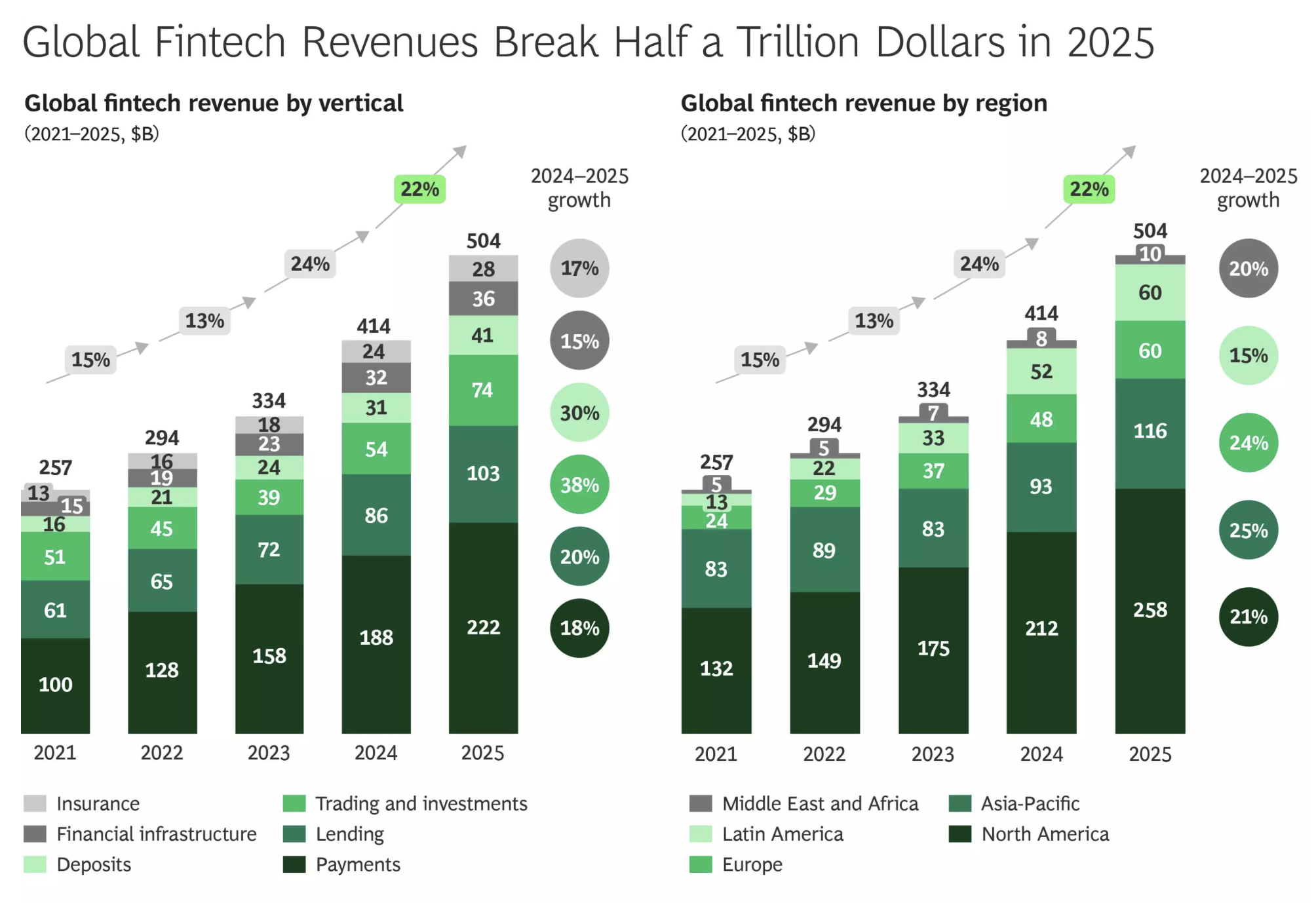
The report records a rise in public listings and dealmaking in 2025. Fintech initial public offerings increased by 50% to 42 deals. Mergers and acquisitions grew from $105 billion in 2023 to $184 billion in 2024 and reached $251 billion in 2025.
The authors describe a shift in business models at scale, with leading fintech firms moving from single‑product businesses to broader financial platforms. Neobanks expanded beyond payments and onboarding into lending, investing, insurance, cross‑border transfers and mass‑affluent wealth management.
On profitability and industry maturity, Deepak Goyal, managing director and senior partner at BCG, called 4% of global financial services revenue “a remarkable milestone for a sector that barely existed two decades ago.” He added the figure “signals how much of the opportunity still lies ahead.”
Inderpreet Batra, who leads payments and fintech at BCG, described the sector as more disciplined and mature after earlier reset years, noting that the firms leading today are profitable and expanding into new products and geographies.
Technology adoption is a key factor cited in the report. BCG’s analysis finds fintechs that embed artificial intelligence across operations can achieve up to five times greater developer productivity. The report identifies the strongest near‑term gains in engineering, underwriting, compliance and customer support, where changes to workflows are driving improvements beyond simple tool deployment.
Steve McLaughlin, chief executive of FT Partners, warned of a gap between firms that have made AI foundational across finance, accounting, customer service and fraud, and those using AI for isolated tasks. He added that large firms are investing heavily in AI but that capital alone has not produced breakout capabilities: “The difference comes down to management, engineering talent and the drive to actually rewire the organisation.”
The report highlights product expansion and cross‑border activity as drivers of recent dealmaking. It points to stronger unit economics at scale, targeted acquisitions and increased fundraising for AI and product development as factors reshaping competition within financial services.
The authors advise that pairing capital with talent and organisational redesign to integrate new technologies will be important for firms aiming to scale and diversify their offerings.
Articles by this author