Companies reengineer processes for agentic AI orchestration

Camunda introduced ProcessOS at CamundaCon in Amsterdam to integrate autonomous AI agents into deterministic workflows; Camunda reported freeing 6,000 person-hours and Barclays is piloting onboarding.
Camunda introduced ProcessOS at its CamundaCon conference in Amsterdam, May 19–21, to reengineer business processes for agentic AI orchestration. The company reported that a reworked quote-to-cash flow freed about 6,000 person-hours, and Barclays is piloting agentic customer onboarding using the platform.
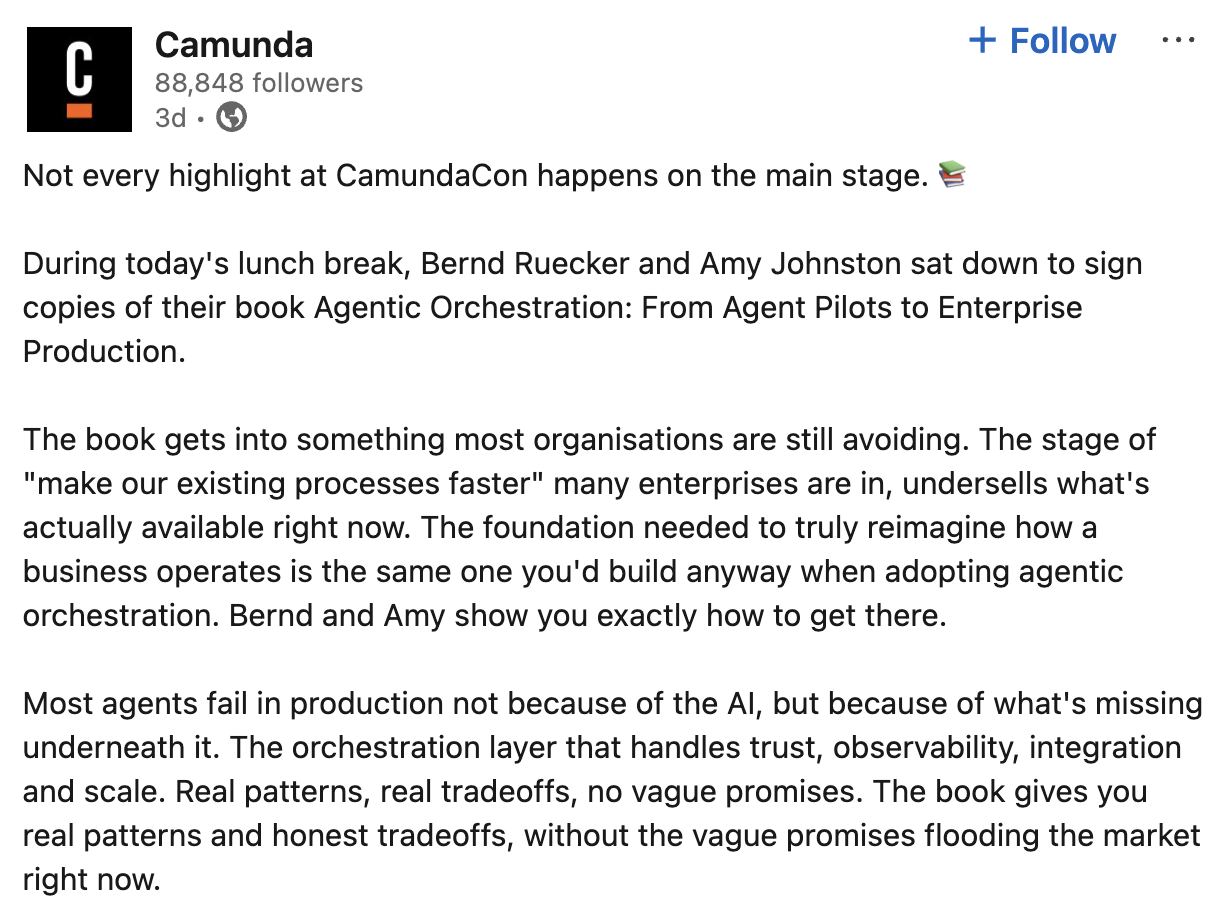
About 1,100 attendees joined the three-day event. Camunda executives explained how ProcessOS connects adaptive AI agents with deterministic workflows so automated agents can perform tasks while enforced rules handle sequencing and approvals.
Jakob Freund, Camunda’s chief executive, told attendees that a customer data agent needs strong human approval controls and deterministic behavior. He called those characteristics “the power of agentic orchestration.” Daniel Meyer, chief technology officer, described ProcessOS as “an agentic operating system” designed to reengineer processes and optimize them continuously for AI.
Camunda used ProcessOS internally to redesign its quote-to-cash process. The company reported improvements in cycle time, efficiency and error reduction. Clemens Morgenroth, chief financial officer, calculated the time savings at roughly 6,000 person-hours, based on a prior average of five hours per deal.
Barclays is testing agentic orchestration for customer onboarding and financial crime checks. Lily Wang, chief information officer for wholesale client onboarding and group financial crime at Barclays, said ProcessOS addresses a common barrier to enterprise AI adoption: relying only on current processes can stall transformation. Gautam Verma, head of financial crime core platforms and client due diligence technology at the bank, outlined a three-agent model under pilot: an agent to collect customer data from multiple sources, a data intelligence agent to assess applicable policies, and a policy agent to carry out required steps. Verma said the orchestration layer is deterministic to coordinate multiple systems and internal handoffs and to shorten onboarding that can otherwise take months.
Analyst research points to a shift from task-level automation to enterprise-scale process orchestration that blends adaptive AI behavior with deterministic workflows. A Q2 2026 industry report found vendors positioning orchestration as a backbone that combines process intelligence, modeling, execution, monitoring and data foundations. The report also noted a focus from vendors and customers on governance, auditability and hybrid execution models supporting event-driven automation and human-in-the-loop controls.
Agentic orchestration refers to systems in which autonomous AI agents perform specific tasks such as data collection or policy assessment, while an orchestration layer enforces order, constraints and approvals. Deterministic workflows set the sequence and limits for those agents, and human sign-offs remain at key decision points to preserve compliance and traceability.
Camunda presentations and the Barclays pilot provide examples of applying agentic AI to processes that historically relied on manual handoffs and spreadsheets. Providers and analysts emphasize governance and hybrid execution as elements intended to make AI-driven orchestration auditable and suitable for enterprise use.
Tags
Articles by this author